
IERP realisations publications
Achievements and publications

Experimental capabilities demonstrated through scientific projects

IERP capabilities are best understood through the scientific projects they make possible.

Since 2000, its facilities and teams have contributed to more than 300 publications involving rodents and fish, from model production to in vivo studies, functional phenotyping and the development of new methods.

These publications document the infrastructure’s uses and the diversity of collaborations to which it contributes.

Scientific output developed with our partners

IERP contributes as an experimental infrastructure and scientific partner to projects led by different teams.

This involvement can also take place through funded collaborative projects. IERP is a partner in the ANR ThermoFish project (ANR-24-CE35-3882), which studies the adaptation of fish novirhabdoviruses to climate change.

Alongside service provision and supported access to facilities, IERP can therefore contribute scientifically to structured projects, including ANR, PEPR and European programmes, according to the partnership’s scope.

Depending on the study, its contribution may include:

  • animal production or housing
  • model design or adaptation
  • infection studies and other experimental interventions
  • in vivo procedures
  • longitudinal monitoring
  • functional phenotyping
  • method development
  • scientific contribution to analysis or publication

The level of involvement varies with the project and is agreed with the partners.

Key figures

Scientific output associated with IERP

More than 300 publications 

associated with IERP activities since 2000

More than 15 publications per year 

since 2020

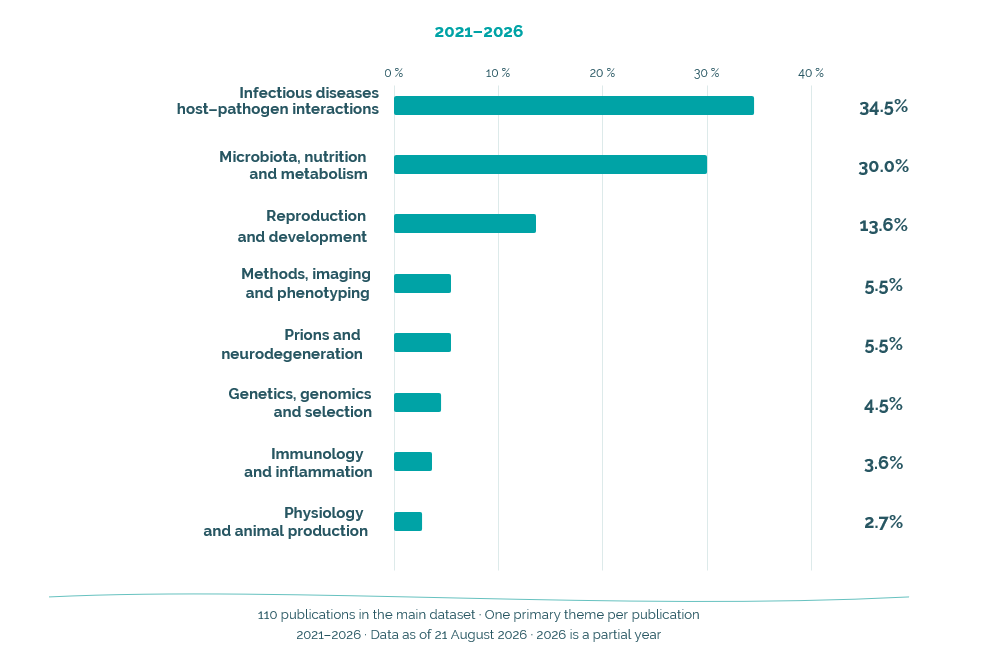
Thematic distribution of the analysed corpus

V032_11_Publication_Themes_Bars_Web

The thematic overview covers 110 publications from 2021 to 2026, based on data compiled on 21 August 2026. It describes publication history rather than the distribution of the current service offering.

Find IERP publications in HAL

Find the publications indexed in the IERP HAL collection.

→ Browse the HAL collection

HAL : Dernières publications

  • [pasteur-05705815] Double-Stapled Peptide Scan Yields Potent Fusion Inhibitors of Respiratory Syncytial Virus

    Abstract Respiratory syncytial virus infection (RSV) is a major global health concern, particularly in infants and elderly populations. In this work, we have screened and identified 3 double-stapled peptides derived from a minimal domain of the RSV F heptad repeat, namely 3/4i, 3/4m, and 4/4g, which are potent inhibitors of RSV fusion and remain active against viral escape mutants resistant to small-molecule fusion inhibitors. Our structural activity relationship (SAR) analysis demonstrates that combining a limited set of staples is sufficient to achieve high antiviral potency. X-ray crystallography revealed that the enhanced potency of 3/4i and 3/4m primarily arises from strong hydrophobic interactions between the N-terminal staple and the trimeric HR1 coiled coil of RSV F. In vivo pharmacokinetic, imaging, and feasibility studies in RSV-infected Balb/c mice further support intranasal administration as a promising route for delivering these stapled peptides to the lung, highlighting their potential as therapeutics against RSV.

    ano.nymous@ccsd.cnrs.fr.invalid (Nadège Pidoux) 28 Jul 2026

    https://pasteur.hal.science/pasteur-05705815v1
  • [anses-05703486] Adaptation des Novirhabdovirus de poissons aux changements climatiques

    Les maladies virales des poissons constituent une menace importante pour le développement et la durabilité de l’aquaculture. Les Novirhabdovirus responsables de la septicémie hémorragique virale (VHSV) et de la nécrose hématopoïétique infectieuse (IHNV) sont des pathogènes majeurs en aquaculture. Ils infectent plusieurs espèces de poissons d’eau froide (4-15 °C), mais ne sont plus infectieux à des températures supérieures à 20 °C. Le changement climatique soulève des questions quant à l’adaptation de ces virus à l’augmentation des températures. Ces deux virus ont donc été thermo-adaptés en culture cellulaire par l’augmentation progressive de la température jusqu’à 25 °C. Les variants sélectionnés ont acquis une réplication efficace à 25 °C, tout en conservant la capacité à se répliquer à basse température, à l’instar des souches parentales. Le séquençage du génome entier a révélé que 11 à 15 substitutions d’acides aminés suffisaient à permettre la réplication à 25 °C. Ces mutations sont réparties dans toutes les protéines virales. Nous avons ensuite mis au point des systèmes de génétique inverse pour ces variants et validé leurs séquences génomiques. Afin de déterminer les gènes et substitutions nécessaires à la thermo-adaptation, de nombreux virus chimériques ont été produits par échange de gènes entre les génomes thermo-adaptés et parentaux, puis comparés in vitro à différentes températures. Ces résultats démontrent qu’une combinaison de gènes est indispensable à la thermo-adaptation. In vivo, les infections chez la truite à 10, 20 et 23 °C montrent que ces variants sont fortement atténués chez leur hôte naturel. En revanche, le variant IHNV thermo-adapté se réplique efficacement à 20 °C et 25 °C chez l’embryon de poisson-zèbre, entraînant l’apparition de signes cliniques et la mort. L’identification de marqueurs viraux conservés de thermo-adaptation sera d’un grand intérêt pour la surveillance épidémiologique des isolats de terrain qui provoquent déjà des épidémies à des températures plus élevées.

    ano.nymous@ccsd.cnrs.fr.invalid (Claire Fauvet) 24 Jul 2026

    https://anses.hal.science/anses-05703486v1
  • [hal-05700954] Cis-aconitate therapy protects against influenza mortality by dual targeting of viral polymerase and ERK/AKT/NF-κB signaling

    <div><p>The influenza virus poses a significant global health challenge, causing approximately 500,000 deaths annually. Its ability to evade antiviral treatments and vaccine-induced immunity underscores the need for novel therapeutic approaches. Our study identifies cis-aconitate (cis-aco), a mitochondria-derived metabolite, as a potent dual-action agent against influenza, independently of its metabolic derivative, itaconate. Cis-aco impairs viral polymerase activity, resulting in decreased viral mRNA expression and protein synthesis, as observed for the influenza A/Scotland/20/74 (H3N2) strain. This antiviral effect was further confirmed across multiple influenza A and B strains, as well as in ex vivo human airway and lung organotypic models. Beyond its antiviral properties, cis-aco exhibits potent anti-inflammatory effects, disrupting key inflammatory cascades and reducing the secretion of inflammatory mediators. In a mouse model of influenza pneumonia, cisaco mitigates viral replication, inflammation, and immune cell activation, significantly improving survival. Notably, its efficacy persists even when administered at later stages of infection, when oseltamivir/Tamiflu® is no longer effective. These findings position cis-aco as a promising influenza treatment, combining antiviral and anti-inflammatory benefits within a clinically relevant timeframe.</p></div>

    ano.nymous@ccsd.cnrs.fr.invalid (Adeline Cezard) 22 Jul 2026

    https://hal.inrae.fr/hal-05700954v1
  • [hal-05693908] O‐Acetyl‐Serine Supplementation Enhances Insulin Secretion and Improves Postprandial Glycaemia in Lean and Prediabetic Mice

    Type 2 Diabetes (T2D), often preceded by reversible prediabetes, poses a major health challenge. Targeting early glucose dysregulation is a promising preventive strategy. Amino acids and their derivatives are emerging as key regulators of glucose homeostasis. Here, we investigate the role of O-acetyl-serine (OAS), a serine-derived metabolite produced by plants and microbes, including those of the gut microbiota, in glycaemia regulation. We developed a targeted method to quantify OAS in plasma and tissues, showing that it enters circulation and transiently accumulates in the pancreas. In vivo, OAS specifically and dose-dependently improves postprandial glycaemia in lean mice. Mechanistically, OAS acts as a glucose-dependent insulin secretagogue: a single oral dose increased pancreatic OAS levels by ~100-fold and amplified glucose-stimulated insulin secretion by 3.7-fold, without affecting basal insulin levels. In vitro, OAS enhanced insulin secretion in both INS-1 cells and rat islets, confirming a direct effect on pancreatic β-cells. OAS also increased GLP-1, but not GIP, levels at baseline and after glucose challenge. However, in vivo treatment with the GLP-1 receptor antagonist exendin (9-39) revealed that GLP-1 signaling only partially mediates OAS's effects, consistent with OAS direct action on insulin secretion. Finally, OAS restored glucose tolerance in a prediabetic mouse model induced by high-fat diet, without altering insulin sensitivity. This improvement was associated with increased postprandial insulin and GLP-1 levels. Together, these findings identify OAS as a glucose-dependent insulin secretagogue with therapeutic potential to enhance insulin secretion and prevent progression from prediabetes to T2D.

    ano.nymous@ccsd.cnrs.fr.invalid (Clara Benatar) 15 Jul 2026

    https://hal.inrae.fr/hal-05693908v1
  • [hal-05693754] Improving ulcerative colitis prospects through fecal microbiota transfer: atypical donor microbiota can boost success rate

    Fecal microbiota transfer (FMT) has been used with variable success in the experimental treatment of ulcerative colitis (UC), and efforts to improve its efficacy very much remain a matter of trial and error. We recently predicted that atypical donor microbiota could improve results. Here, we provide experimental support for this prediction in a rat model where we induced a transition of the intestinal ecosystem to an alternative state characterized by chronic low-grade inflammation and dysbiosis. While autologous FMT did barely or not enhance the restoration of a healthy microbiota compared to a control group without FMT, the atypical allogenic microbiota from one of two donor rat strains proved remarkably successful in the restoration of a healthy microbiota, in some cases accompanied by a healthy distal colon histology. These results allow the rationalization of research efforts towards improvement of FMT efficacy in humans, and indicate that (initial) success of FMT should be monitored at the microbiota level as much as at the level of clinical symptoms. More importantly, they provide further support for our earlier published, clinical-data-based, conceptual model of the intestinal ecosystem which suggests promising opportunities for therapeutic innovation in UC treatment. This model notably predicts that, and explains why, symbio-therapy, acting on both microbiota and inflammation, may be more efficient than conventional inflammationdirected therapies, and can be used to guide and monitor treatments.

    ano.nymous@ccsd.cnrs.fr.invalid (Maarten van de Guchte) 15 Jul 2026

    https://hal.inrae.fr/hal-05693754v1

Citing IERP in a publication

Citing the infrastructure correctly helps identify its contribution, document the use of its resources and track the studies it supports.

IERP DOI: 10.15454/1.5572427140471238E12

Materials and Methods :

All animal experimentations were performed in Infectiology of Fishes and Rodent Facility (IERP, Centre INRAE de Jouy-en-Josas: https://doi.org/10.15454/1.5572427140471238E12 ; member of the National Infrastructure EMERG’IN).

Acknowledgements :

Infectiology of Fishes and Rodent Facility, https://doi.org/10.15454/1.5572427140471238E12 .

Building a new collaboration

The publications presented illustrate selected uses of IERP and do not constitute a closed catalogue of models or services.

If your question requires adaptation of the model, procedures or measurements, the team can assess feasibility.